Showing posts with label urban agriculture. Show all posts

Sunday, September 9, 2012

Detroit, Part 4

Potato plants carry on the automotive industry tradition!
The building in the background is unfortunately now a see-through building.  Because the city's ash trees are dying due to the Emerald Ash Borer, the city uses this now vacant land as a tree nursery for future transplants.

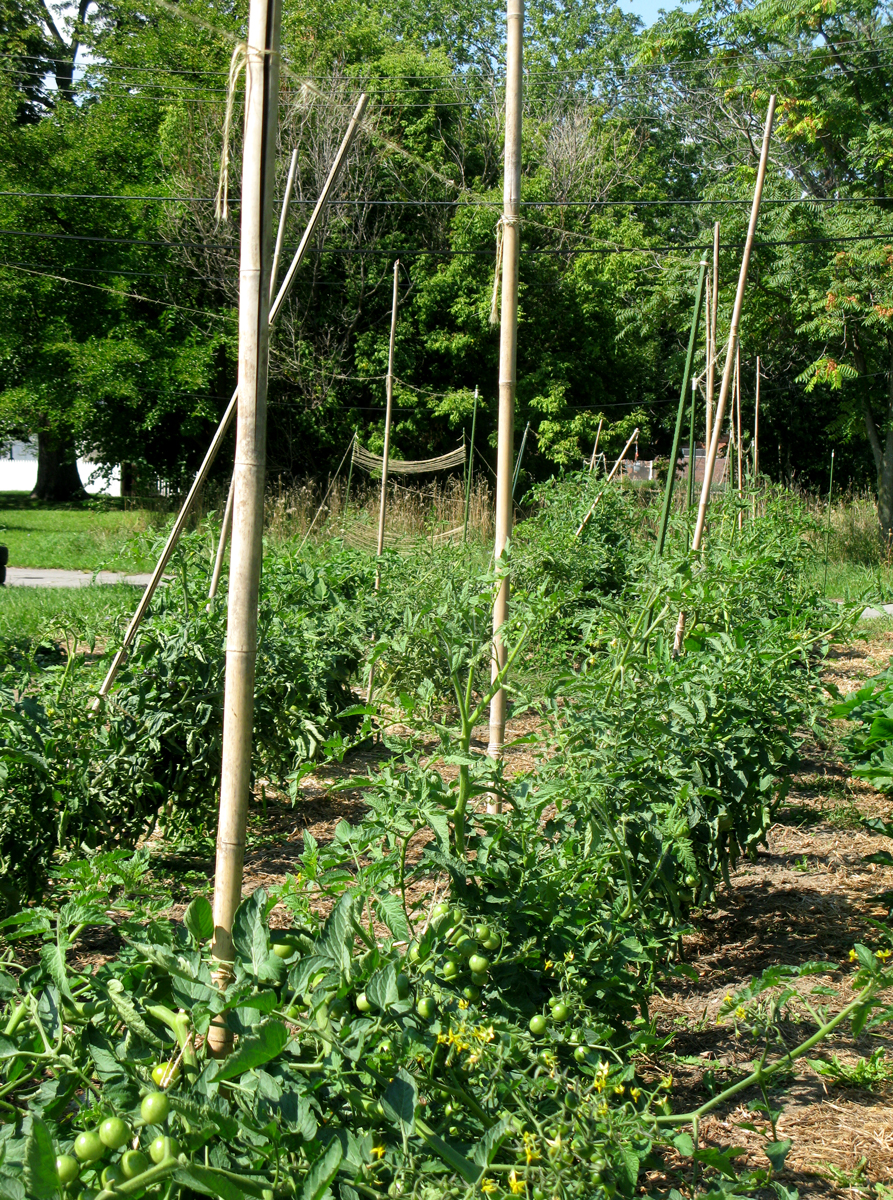
Nearby, surrounded by an expanse of lawn, there were raised beds and this long row of tomatoes, for selling at a market.
With another view of the butterfly and thistle, we now say goodbye to the Detroit blogs. Seeing the empty expanses and the endeavours to grow food in Detroit had quite an impact on me.  Cities are all so different, and they change and evolve.  I wonder what is ahead for Vancouver with all its high-end construction--what will survive and be viable in the future global economy?  If you want to learn more about Detroit, link here:   Urban Roots

Tuesday, September 4, 2012

Detroit, Part 3

Hope Takes Root is a community garden in the North Corktown neighbourhood. It is one of the older community gardens in the city, originally started in a different site and in its current location since 2002.
This structure collects rain water, essential in the summer.
Hoops, not in use right now, with the water structure in the background.

I liked this creative metal gate.  Beyond it is their bee hive project, helpful to all nearby gardens.  Click here for a video on their active bee hives 
Hope Takes Root, again!
A variety of things are grown here, hops, the usual vegetables, and even apples!


Bikes are a practical way to get around in this depopulated neighbourhood that is lacking the public transit a more populated area would require.  We saw bike racks like these in this garden as well as in a number of other places.
Watch for Detroit, Part 4!

Friday, August 31, 2012

Detroit, Part 2

In the distance behind other growth, you can see corn, beans, and squash (the "three sisters").  One could imagine that years ago, before there was a Detroit, native people grew these same plants near this plot.


 Peppers, tomatoes, and squash are found in this greenhouse.
This corner lot was very neatly kept, but the surprise was the ground cover--it is purslane.  I would never have imagined letting this deeply-rooted weed sprawl, but it probably helps the soil retain moisture.
 Here is a close-up of the purslane.

Watch for Detroit, Part 3!

Sunday, August 26, 2012

Detroit, Part 1

We spent the morning of August 20 exploring one of the depopulated areas of Detroit.  I wanted to see the urban gardens and farms that have been created there.  Uninhabited derelict houses have been removed, and in some areas grass has been planted and is mowed.  Other areas have been left to grow wild.  Streets are deserted, and it is very quiet like being in the countryside, despite seeing buildings in the distance.  The infrastructure is crumbling.  It was eerie to think of all the working people in those neighbourhood, now gone along with their homes. Where are they now?


A back lane, soon to disappear.
The sidewalk disappears into the wilderness.
A crumbling sidewalk, but trimmed and weed-free!  This was next to an extensive corner garden.
 

In case anyone has views to remodel, this house is an example of why not.  Perhaps it is still standing because someone lived in it until recently.
But even the wild plants, and perhaps especially the wild plants, attract great insects!  I came across this scene in one of the gardens.

Watch for Part 2!

Monday, June 4, 2012

Converting Lawns to Edible Gardening--Some Resources

Landscape architect, Senga Lindsay, is launching her new book, Edible Landscaping: Urban Food Gardens That Look Great, at Barbara Jo's Books to Cooks, on Saturday, June 9, 1-3 pm.  RSVP 604-688-6755.

During Salmonberry Days I attended a presentation at the Dunbar Community Centre by Camil Dumont, head farmer at Inner City Farms. Although Inner City Farms is a business venture, their web site is of interest to anyone considering converting their front yard into a vegetable garden.  There is a recent article about the farm in the Vancouver Courier, too. Here are the links.


Inner City Farms
Vancouver Courier article

Monday, July 6, 2009

Mystery Solved!


In 4 previous blogs, (link to Spinach Lovers' Garden in the list of labels), I've had photos of this front yard garden that was growing what I thought might be spinach over the winter and other things in large quantities that I thought were not very practical for a home garden, and yet there was obvious expertise. The mystery is now solved! The garden is part of Kitsilano Farms, a project that converts donated front and back yards into intensive, productive micro-farms. Produce is sold at farmers' markets, sold through CSA programs, given to the land-owners, etc. A similar project on the east side of Vancouver is CityFarmBoy. In Gibsons, there is Backyard Bounty.

Urban Agriculture

The New York Times Magazine of July 5 has an article entitled "Street Farmer" by Elizabeth Royte about Will Allen's inner-city farming project in Milwaukee. I liked these two quotes:

“We need 50 million more people growing food,” Allen told them, “on porches, in pots, in side yards.” The reasons are simple: as oil prices rise, cities expand and housing developments replace farmland, the ability to grow more food in less space becomes ever more important.

Allen predicts that because of high unemployment and the recent food scares, 10 million people will plant gardens for the first time this year. But two million of them will eventually drop out, he said, when the potato bugs arrive or the rain doesn’t cooperate.

This link should work this week: http://www.nytimes.com/2009/07/05/magazine/05allen-t.html?_r=1&ref=magazine